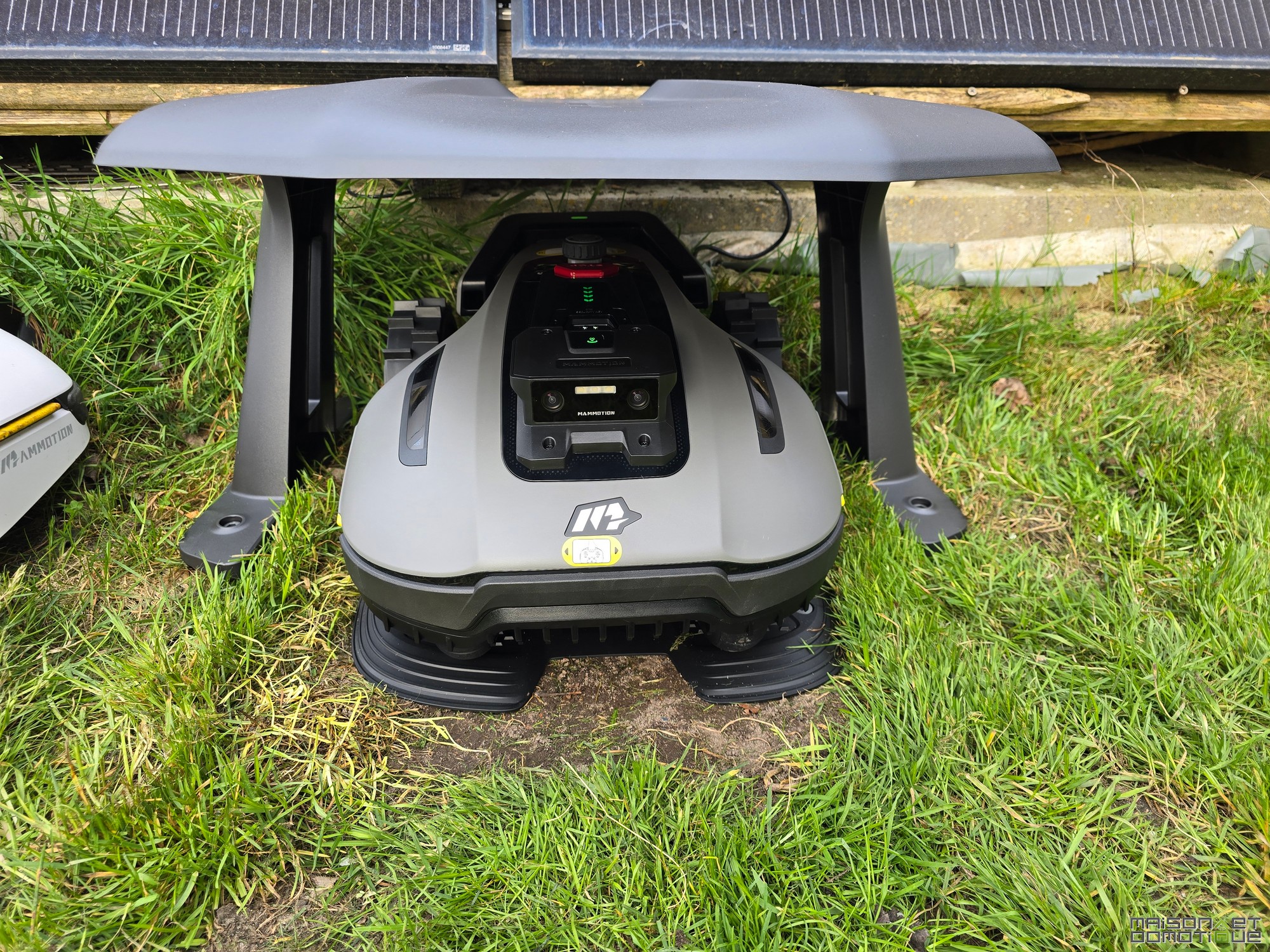
Smart toning, stunning autonomy: test of the Mammotion Yuka Mini 700

Spending weekends pushing a lawnmower under the sun to end up dripping with sweat is a pleasure we gladly leave to our elders (who sometimes enjoyed it). A few months ago, we tested the Mammotion Yuka. Today, it is the Mammotion Yuka Mini that arrives to take over the smallest lawns and literally put an end to this chore, offering a perfectly manicured lawn without lifting a finger. The specifications for this robot? Simplicity, efficiency, and above all, total freedom: no more perimeter cables to bury! It smells like summer, doesn’t it? Let’s see if the promise holds up.
Unboxing the Mammotion Yuka Mini 700
Mammotion offers several variants of its Yuki Mini depending on the area to be mowed: 600 or 800 m². Here, for the tests, I had the opportunity to have the Mammotion Yuka Mini 700.

As usual, Mammotion does not do things by halves. The packaging is compact but organized with obvious care: each element is secured, protected, as if waiting to be pampered. A true testament to attention that reassures right away.


The lawn mower itself is a concentrate of balance between lightness and robustness. It weighs about 10.5 kg, making it light enough to be moved by hand effortlessly, yet heavy enough to ensure good stability in motion.

Its dimensions are designed to navigate agilely in gardens ranging from 300 to 1100 m²: cutting width of 19 cm, length of approximately 57 cm, and a height of just 25 cm. Not a behemoth, therefore, but a solid presence.

Compared to its big brother Yuka, you can immediately see the more compact size, even if the shape remains very close.
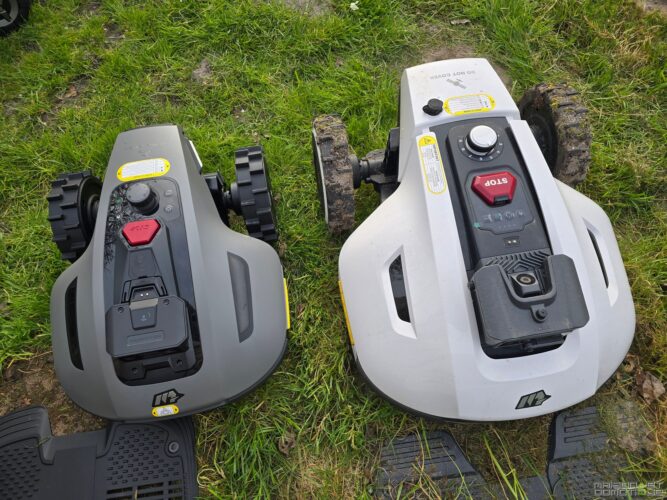
In terms of materials, the Yuka Mini features a rigid grey plastic shell, both matte and smooth, that exudes sturdiness while avoiding unpleasant reflections in the sun. Its design aims to be discreet yet modern: clean lines with soft curves, without excess gadgets or frills, it presents the look of an efficient and professional machine.

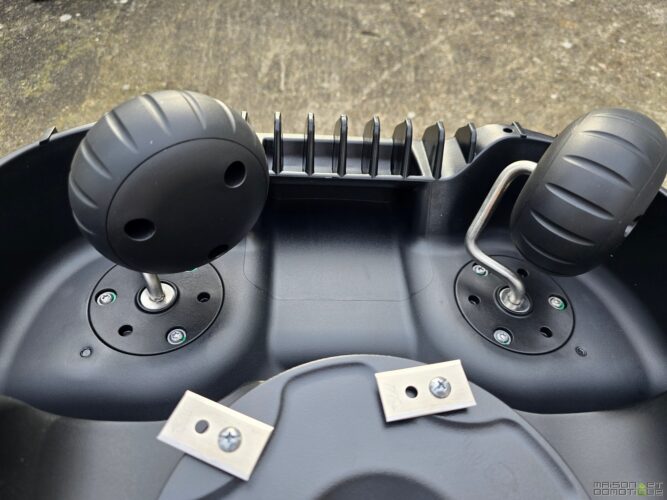
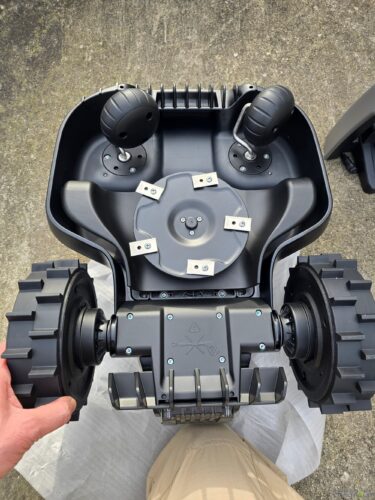
Two large serrated wheels of 21 cm in diameter dominate the rear, providing solid traction even on slightly uneven terrain, while two smaller front wheels (14 cm) facilitate precise direction changes.

These wheels are made of thick rubber, a good idea to avoid slipping on wet grass or loose soil.
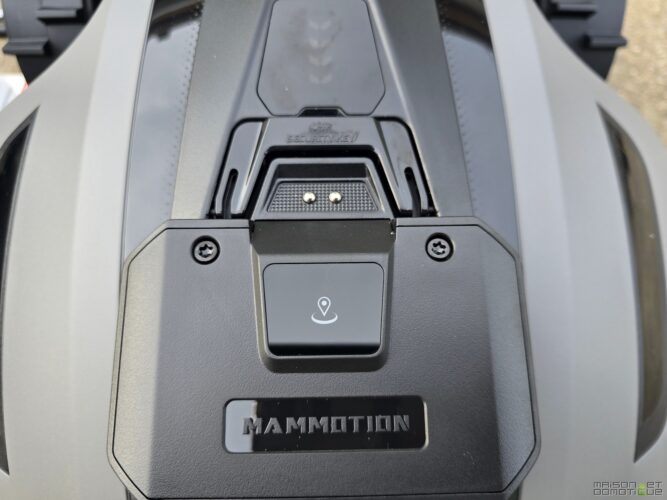
On top of the robot, several elements stand out. The control panel, accessible yet discreet, features four physical buttons: power on, emergency stop, return to base, and menu navigation.

An integrated rain sensor is located on the upper front part, ensuring that the mower knows when it’s best to stop its activities in case of downpours.
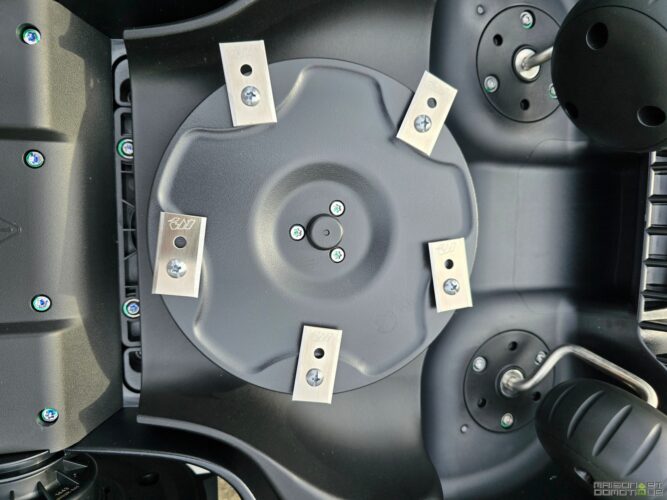
Underneath, we discover what really makes the difference: a 19 cm rotary cutting disk houses five small hardened steel blades, all retractable to avoid accidents. These blades, sharpened to perfection, ensure a clean and even cut, with a manually adjustable height on a knob located at the rear, allowing the cutting height to be adjusted from 20 to 60 mm. This range covers the majority of needs, from closely mowed grass to slightly taller tufts.
The chassis is well protected by a soft bumper all around to absorb contacts.

Unlike some models, this robot does not come with a physical bumper, but its UltraSense Vision sensors provide fine obstacle detection at a short distance, thus avoiding brutal collisions (even if light contact is sometimes unavoidable).
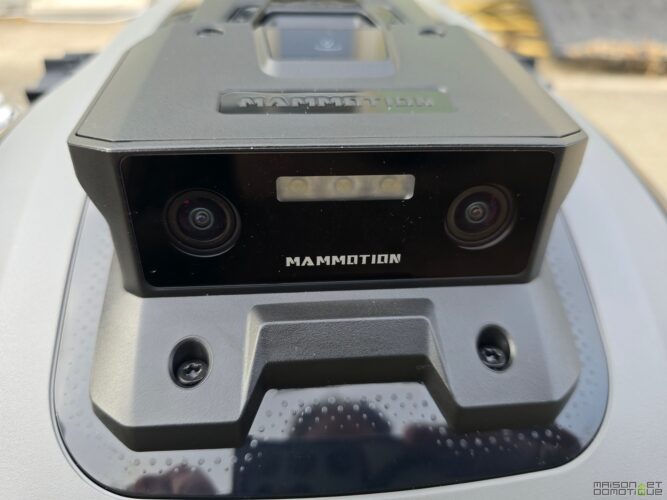
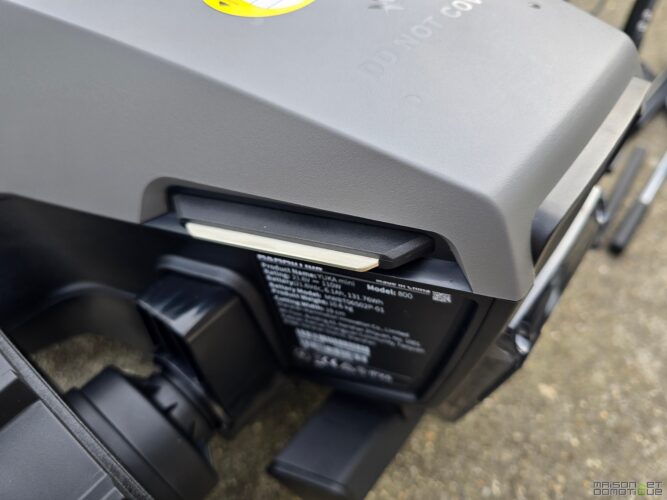
On the waterproofing side, Mammotion has taken care of its baby: the Yuka Mini is rated IPX6, a nice guarantee against a good spring shower or summer downpours. The connections are well protected under watertight covers, perfect for those who fear failures due to humidity.
Finally, the charging station, more than just an anchor point, consists of a compact base with metal contacts and an RTK antenna mounted on a stake.
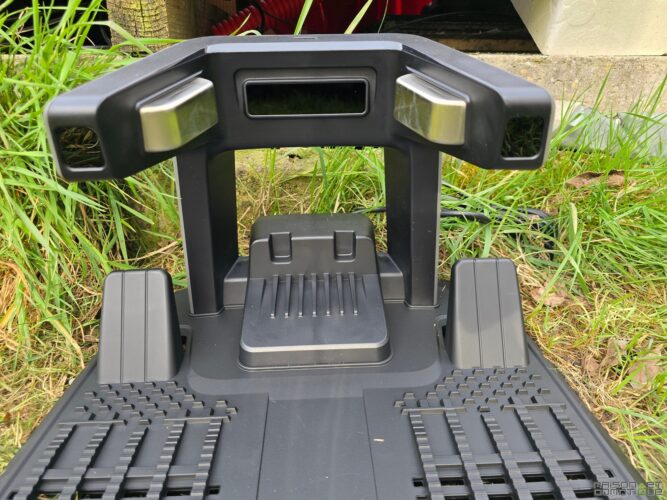
Everything is designed to ensure stability and precision, with the robot-station combination ensuring almost perfect navigation without guide cables. This little duo integrates discreetly into the garden without too much disfiguring the landscape.
It is also possible to obtain a garage shelter as an option. Not mandatory, but a little protection against the elements is always a plus.

In summary, the Mammotion Yuka Mini 700 is not just a pretty autonomous gadget: it is a well-finished machine, designed to last, robust yet agile, with physical characteristics tailored specifically for demanding gardeners who do not want to sacrifice simplicity for performance.
Installation of the Mammotion Yuka Mini 700
Forget the tedious days spent burying a perimeter cable down to the centimeter: here, we can finally breathe! As soon as the unboxing is done, head to the garden, robot on one side, charging station on the other. The adventure can begin. First priority: find the ideal location for the base. It needs a flat, clear area (2 m on each side and 5 m in front, so that the Yuka Mini can maneuver without risking a rabbit punch against the rosebush). The power connects to a standard outlet; the power cable offers a good length, eliminating any hassle to reach the power source.

Second mission, the RTK antenna. This is the brain of the navigation system: it must see the sky at all times, free from dense branches, parasols, or even the metal pergola (yes, a bad idea under a pergola). We stake the pole into the ground, screw the antenna on top, and we’re good to go! The antenna communicates with the robot and the base to allow centimeter-level localization. Note that the RTK antenna can be placed elsewhere than the charging station: it then has its own power supply. This facilitates placement in somewhat complicated terrains.

Let’s move on to configuration: the smartphone becomes the main tool. We download the Mammotion app (Android/iOS), create an account, then add the robot. Once Bluetooth connection is established, the robot signals its presence with a discreet ‘beep’. As soon as pairing is done, the app guides you through each step logically: pairing with the station, linking with the antenna, updating firmware… Three minutes flat and a few taps later, all that’s left is to connect to Wi-Fi or 4G (depending on the model). Convenient: the 4G subscription is free for the first year, allowing you to test remote monitoring, even from the beach at Arcachon.
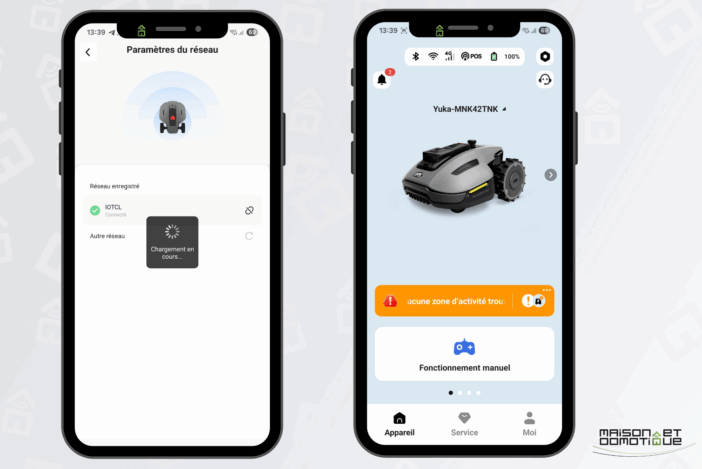
Now it’s time to map the terrain! We choose “create map” in the app, then physically guide the robot: move forward, turn, navigate around trees, the pool, the terrace… A bit like piloting a little remote-controlled car (except that later, the car mows the grass by itself).
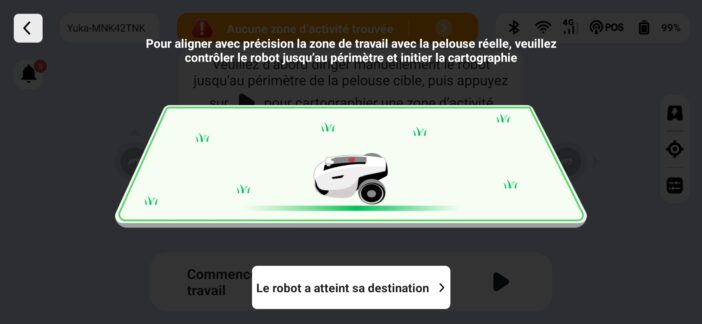
This model also incorporates AI for mapping, similar to the Navimow X350 we previously reviewed. In AI mode, the robot automatically detects borders and walls, allowing it to map by itself. We only take control when the terrain gets a bit more complex.
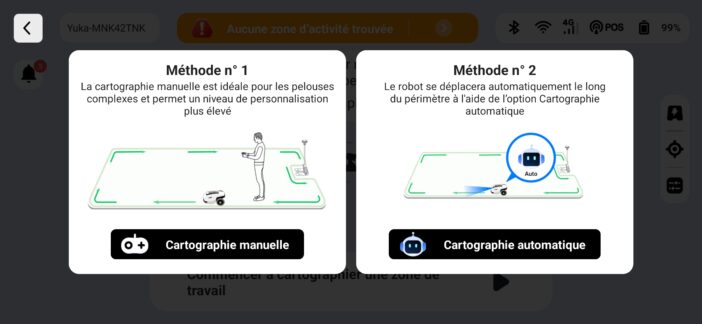
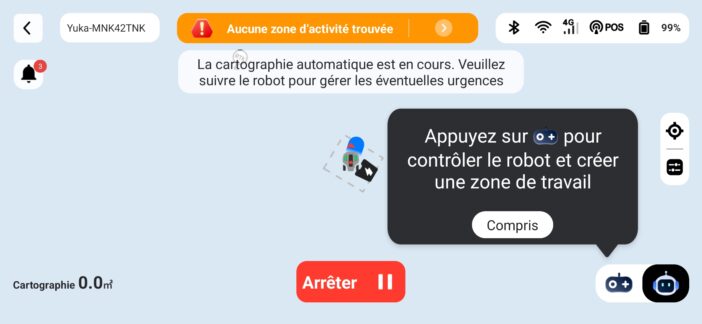
Once the perimeter is defined, it’s time to configure mowing zones: up to seven different ones, each with its own schedule. No chance of making a mistake: we exclude flower beds, adjust the cutting height, and voilà! The Yuka Mini knows perfectly where it has to go… and what it must avoid!
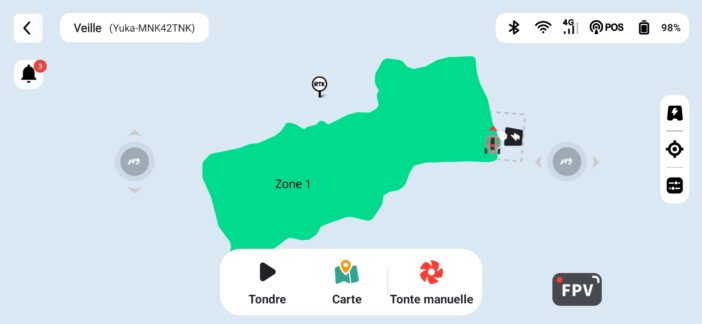
The configuration is not just a technical gadget. Safety settings to configure, notifications to activate (if the robot gets stuck, if rain threatens, or simply at the start of mowing), everything is customizable. And the first session reveals the true strength of the whole system: quick startup, precise mapping, clear communication. If the Wi-Fi network struggles to cover the entire area (thick walls, old manor…), the 4G takes over without a hitch.
In just a little over an hour, without effort or cold sweats, the mower goes from the box to precision cutting, ready to tackle your domestic jungles. Mammotion has understood everything: making the installation as smooth as a bucolic spring walk! We love it!
User Feedback: An (Almost) Flawless Lawn Companion in Daily Life
The Mammotion Yuka Mini 700 has taken up residence in my garden (800 m², a U-shaped plot dotted with trees and obstacles, with a narrow corridor between two areas. The ideal playground for a demanding robot. After the seamless configuration already mentioned, the robot tackled the grass without hesitation, displaying a rather refreshing confidence from the start. The impression is guaranteed when it starts its first mapping: the movement is methodical, almost hypnotic, tracing the lawn’s boundaries with the precision of a surveyor, relying on both the RTK antenna (placed at the back of the garden, as per the manual) and its onboard sensors.
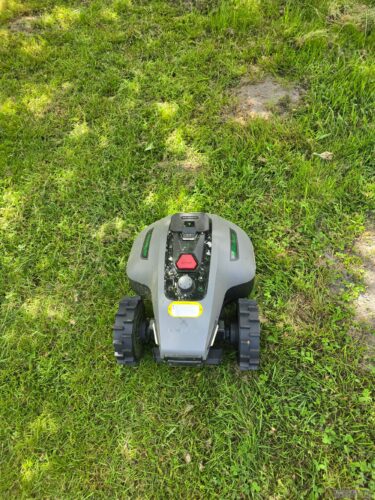
Once it has taken its bearings, the Yuka Mini attacks the cutting zone by zone. In my case, I divided the terrain into three parts: a main zone at the back of the house, a zone on the side with a narrow passage, and a third in front of the house, where cars are often parked. The application allows you to set different schedules for each area: the main zone in the morning, the side zone in the afternoon (while the kids play elsewhere), and the front zone more occasionally, when the cars are gone.
A Cutting Experience That Approaches Perfection
The Yuka Mini 700 stands out for its mowing quality: the passage is clean, even, without the “random overlap” effect that some robots still show, even in this price range. The disk of five mini blades ensures sharp cuts. Even the slightly tough spring grass doesn’t resist it. Set to a cutting height of 40 mm to achieve a “football field” finish, and the result is impressive. The robot leaves no traces or clumps of residue, even when beset by the whims of the wind.
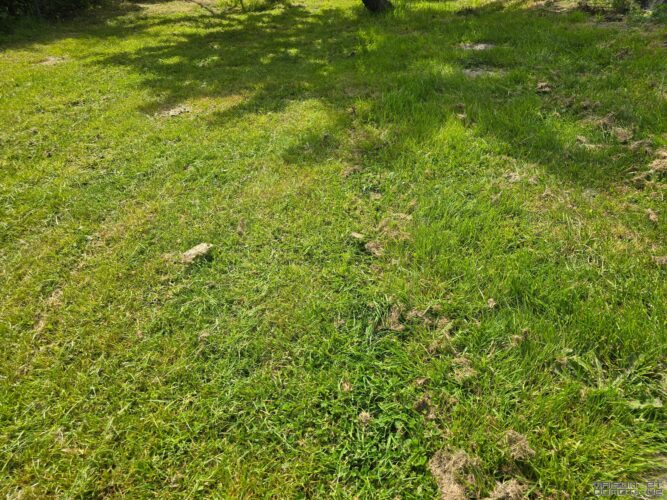
The secret? An effective crossed mowing mode, trajectories given by artificial intelligence (sometimes, you can feel the robot hesitating, backing up, correcting, then taking off clean, as if it were thinking!); and the possibility to prioritize speed or precision in the settings. When the growth is vigorous, I opt for the “express” zigzag mode: it loops the 800 m² in under 3 hours, including charging, without losing the expected finish.
A True Chameleon on Grass… With a Few Limitations
In terms of mobility, it tackles 30% slopes effortlessly (in my case, a gentle slope behind the hedge), and also handles slightly uneven terrain without any issues. The large serrated rear wheels dig their furrows in wet grass, although it must be acknowledged that in wet conditions, traction decreases: one stormy morning, it got stuck twice on a spongy patch. Nothing alarming, it then wisely returned to the base, waiting for its time.
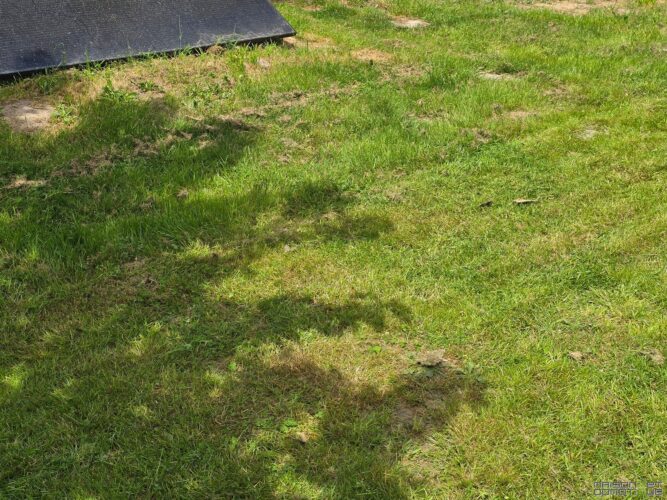
Obstacles? No unpleasant surprises. The robot stops dead in front of stray toys left by the youngest, navigates around flower pots without hitting them, and weaves with rare delicacy between tree trunks and garden furniture. The detections are precise: never caught off guard by the adventurous cat that likes to roam, nor by the soccer balls that are lying around. But beware: on very low or flat objects (like a stepping stone flush with the ground), it sometimes climbs slightly before detecting the error and backs off, without any damage.
Noise Management and Autonomy: The Zen Attitude
It’s impossible not to mention the silence of the Yuka Mini. At 58 dB measured from 1 m away, it completely forgets itself during the day, and even during nighttime cycles. No worries about disturbing the neighbors. But we’ll still avoid using it at night to preserve the little nocturnal life in the garden. The robot will recognize a hedgehog without a problem, but let’s allow these little creatures to live in peace; we have all day to mow! ;-)
No worries on the safety side either: automatic locking when lifted, almost instantaneous stopping of the cutting disk, notifications on the smartphone as soon as an incident is detected.
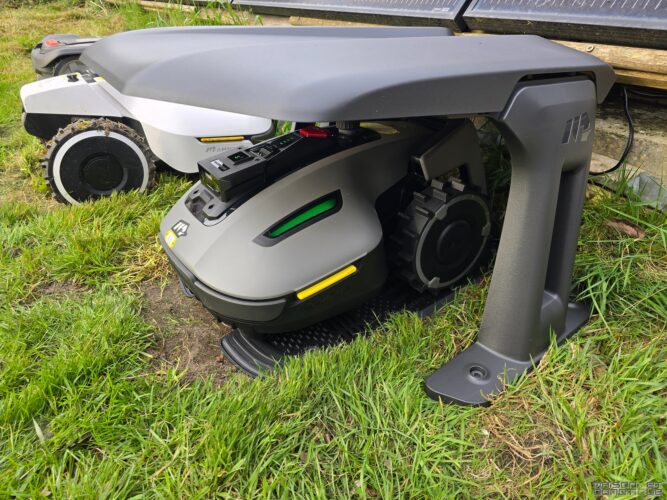
In terms of autonomy, covering 270 m² of continuous mowing per charge, it manages my terrain in three cycles a day, knowing that it recharges in about three hours. Autonomy is well managed: it systematically returns to the base before running out of battery, and it shows rather intelligent weather management. One rainy morning, mowing was interrupted; as soon as the calm returned, the robot resumed as if nothing had happened. The charging station, well placed and clean, has always managed to retrieve the robot without any hassle.
The App: The Master Asset of the Routine
Remote control (even on the way to work), real-time tracking of the robot, security alerts, and ultra-flexible scheduling. I even tested FPV monitoring for fun, watching the progress live. A great way to keep an eye on what’s going on in the garden when you’re not there.
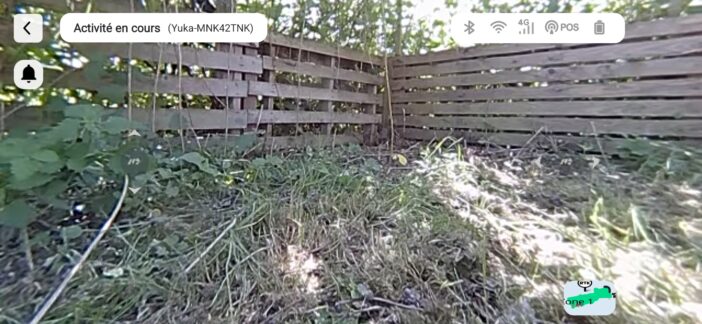
Zone customization, fine height management, and weekly scheduling gives a sense of total control.
A Truly Wireless Robot… With Some Caveats
Of course, not everything is perfect. The uncut strip of 10 to 12 cm at the edge: impossible to cut, you have to bring out the string trimmer for finishing. But this is common for robotic mowers of this type.
On uneven soil, a few hesitations can occur, requiring the relocation of garden furniture or more precise delimiting of obstacles in the app. A positive point: it never got stuck in the test between two fixed structures (swing set and bench), although, once or twice, it remained stuck in front of a protruding tree root.
Energy Efficiency, Weather, and Maintenance: The Simple Routine
Very economical in terms of consumption (less than 30 kWh/year according to my readings on a connected outlet), the Yuka Mini does not inflate the electricity bill. Winter storage is simplified: it can be stored in the garden shed, battery dry, chassis quick to clean. In full season, a quick brushing every ten days does the trick.
Tip: remember to check the cleanliness of the base and contacts once a month for an ideal connection.
A Real Change, Really Connected
This robot has not only mowed my lawn: it has truly changed my relationship with gardening: regained freedom on weekends, no more constraints related to the weather (or almost!), collaborative handling with the kids (who have given it a nickname, proof that it has been accepted by the family), and the pleasure of rediscovering a lawn that is “always ready,” whether it rains, it blows, or even during a little heatwave (the robot slows down in very dry grass, a sign of reasonable management of constraints).
The promise of the Mammotion Yuka Mini 700 is a well-maintained garden, everywhere, all the time, without sacrificing technique or the joy of seeing the lawn thrive. Impressive… even after years of testing competing robots!
Conclusion
In the end, the Mammotion Yuka Mini 700 does not just mow the lawn; it redefines the way to approach garden maintenance. Its navigation precision, made possible by RTK GPS and intelligent sensors, guarantees a well-maintained lawn while eliminating the constraint of perimeter cables. A real plus that changes the game. Its fluid installation, combined with a well-designed app, makes it easy to grasp, even for the less tech-savvy.
On the ground, this little robot proves to be reliable, efficient, and pleasantly discreet, managing both complex areas and moderate slopes (up to 45%). The cutting quality does great honor to Mammotion’s reputation, even if a few manual touch-ups are still necessary on narrow borders.
The autonomy is suitable for covering respectable areas with minimal recharging and respect for weather conditions, and its robustness against the elements reassures for an investment over several seasons. In terms of connectivity, the Yuka Mini integrates easily into a modern smart home environment, with a real plus for remote monitoring and fine tuning of zones.
Despite a few small limitations (traction in wet weather, uncut edge strips, or slight sensitivity to very low obstacles), this robot holds its promises, bringing a great time-saving benefit without sacrificing quality. The Mammotion Yuka Mini 700 thus presents itself as an appreciated solution for modern gardeners seeking intelligent, simple, and effective maintenance.
In short, for anyone wanting to finally turn the page on traditional mowers without compromising on quality, the Yuka Mini 700 makes a difference and offers a way to fully enjoy the garden without lifting a finger! For small gardens up to 800 / 1000 m², it is simply on the top step of the podium alongside the Navimow i105/108e, which is its only equivalent in terms of functions / price.
Ces articles pourraient aussi vous intéresser:


0 reaction