


Résumer cet article :
Solar energy has changed many things in self-consumption. It allows for local production, reduces part of the electricity bill, and better utilizes one’s roof. With the successive increases in electricity prices in France in recent years, it has become a widely adopted solution. However, solar energy also has a very simple limitation: it only produces during the day, and far better in nice weather than in the dead of winter. It is precisely during this period that needs increase, whether for heating, agricultural activities, workshops, outbuildings, or small professional buildings. This is where wind energy regains real interest, not as a competitor to photovoltaics, but as a logical complement. Freen precisely highlights this positioning with the Freen-9, a small vertical wind turbine of 9 kW designed to operate in real conditions, with variable winds, and to integrate into hybrid systems combining solar and storage.
A wind turbine designed to fill the “air gap” of photovoltaics
When looking at a photovoltaic installation over an entire year, the discrepancy quickly becomes evident. Production is generous in spring and summer, then it drops when days shorten, the sky clouds over, and the sun stays low. Meanwhile, electrical consumption rises. For a well-equipped house, a farm, a workshop, or a small activity in a rural area, this discrepancy can quickly become frustrating. The promise of the Freen-9 is precisely to provide a complementary production source, capable of operating during periods when solar energy becomes less efficient. Freen also presents its model as a solution suited for hybrid systems combining wind, solar panels, and batteries, to achieve more consistent production throughout the year.
This point is far from trivial. In a self-consumption project, the goal is not only to produce a lot but to produce at the right time. A small power wind turbine thus makes perfect sense when it supports an existing PV installation, especially in areas where wind is present in autumn and winter. In short, solar covers needs very well when the weather is nice, and wind energy can step in when the weather becomes less favorable for the panels. This is a more flexible, balanced approach, and frankly more interesting than a 100% single-source reasoning.

The choice of vertical axis to better adapt to the terrain
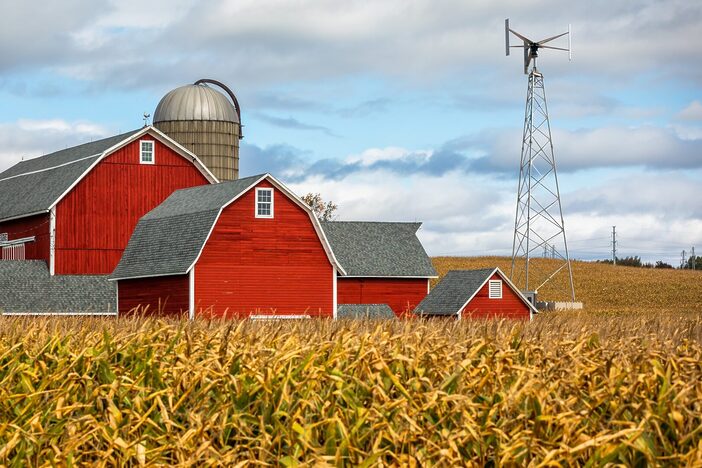
The Freen-9 is not a conventional horizontal wind turbine. Freen has opted for a vertical axis architecture, Darrieus type, with a rotor diameter of 6 meters, a rotor height of 4 meters, and three aluminum blades. On paper, this design has several very concrete advantages. First, it does not need a mechanism to orient itself against the wind. The wind turbine is capable of working regardless of the air flow direction, which simplifies its operation and installation. Then, this type of machine is better equipped to manage turbulent or multidirectional winds, precisely those often encountered in real environments, around buildings, farms, mixed areas, or terrains that do not resemble a perfectly clear postcard of flatland.
As Kate Samedova, sales manager at Freen, explains: “The Freen-9 is designed for real conditions, not for the idealized environments of wind farms. It operates effectively at low to moderate winds, starting from approximately 3 to 3.5 m/s and up to 17 m/s. This makes it perfectly suited for residential use, agricultural operations, and decentralized energy systems. The goal is not to compete with large industrial wind turbines, but to provide a decentralized solution that better meets daily energy needs.”

Serious technical specifications for a small wind turbine
The Freen-9 has a rated power of 9 kW. Its starting speed is given from 3.0 m/s. The cut-off occurs at 17 m/s, with a survival speed announced at 36 m/s. The wind turbine belongs to the IEC III and IV wind classes, has a swept area of 24 m², and relies on a direct drive technology without gears, with a synchronous generator using permanent magnets. All this is complemented by an electromagnetic brake, integrated monitoring, a connection via AC charge controller, an announced lifespan of 20 years, and compliance with the IEC 61400-2:2013 standard dedicated to small wind turbines.
The size is still substantial, of course. The turbine alone weighs 650 kg, the tower, which is height adjustable to meet a wide range of requirements (from 4 to 18 meters), is stated to weigh 2,500 kg, and the total height can reach approximately 20 meters. The indicated footprint is 36 m². So we are dealing with a real energy equipment, not a “green” gadget placed at the back of the garden to look nice. But in return, Freen claims here a machine capable of delivering serious production in a format that remains compatible with residential, agricultural, or community projects. The price starts at around €11,610 excluding tax, which already helps to determine the product’s positioning.
Annual production that depends on the site… but gives a good idea
As always with wind energy, everything depends on the wind actually available on site. This needs to be reiterated, as this is the point that makes all the difference between a relevant project and a disappointing installation. Freen nonetheless publishes theoretical annual production values based on a Rayleigh distribution. The technical sheet indicates thus 2.8 MWh per year for an average wind of 4 m/s, 6.6 MWh at 5 m/s, 12.1 MWh at 6 m/s, 18.1 MWh at 7 m/s, 23.7 MWh at 8 m/s, and up to 33 MWh around 12 m/s before a slight drop at higher speeds in the provided table. These figures give a good idea of the potential, while remaining, as Freen specifies, indicative values calculated under standardized conditions and not a guarantee of production.
This is indeed a rather healthy approach. The manufacturer reminds that the actual efficiency will depend on the site, installation height, turbulence, grid availability, and operating conditions. In practice, this means that a serious wind study remains essential before proceeding. In a good location, the Freen-9 can become a true lever for autonomy. In a bad one, it risks never tapping into its potential. Wind energy does not forgive sloppiness, and that is also what differentiates it from solar energy, which is often easier to estimate.
A discreet operation and a design aimed at reduced maintenance
One of the recurring topics with a small wind turbine is noise. Freen highlights a noise level of 45 dB at 100 meters. On paper, this is reassuring, especially for a machine of this size. The brand also explains that its balanced design, the low number of friction elements, the lightweight blades, and the direct drive without a gearbox help to limit noise disturbances and reduce maintenance needs. The average rotational speed, announced around 90 revolutions per minute, supports this: it remains a relatively slow rotation, with a clear focus on discretion and safety.
Another point emphasized is the impact on the local environment. Freen mentions a design more respectful of the neighborhood and wildlife, using durable and recyclable materials, as well as a structure designed to limit environmental impact throughout the entire lifecycle. Again, these are arguments that matter in the acceptability of a project, especially for installations close to residences, farms, or activity buildings. A small wind turbine should not only produce; it must also be able to gain acceptance. And in this regard, Freen has clearly worked on its product discourse.
A flexible installation, on-grid or off-grid
The advantage of the Freen-9 also lies in its flexibility of integration. The manufacturer indicates that it can be used in both grid-connected and autonomous site configurations. The official page also shows two connection diagrams, on-grid and off-grid, with a connection to a hybrid inverter to balance the system’s power supply. Freen also emphasizes its compatibility with modern photovoltaic installations, which opens the door to very relevant hybrid architectures to maximize self-consumption.

In concrete terms, the most appealing scenario remains that of a setup combining solar panels, wind turbine, and battery storage. During the day, the photovoltaic system covers immediate usages and possibly recharges the storage. As the sun goes down or winter settles in, the wind turbine can take over as soon as the wind picks up. And if the grid becomes unstable or expensive, the battery helps to smooth out the flows and keep a useful reserve. For a house in a rural area, a farm, an isolated lodge, a workshop, or even a small energy community, this type of installation starts to make a lot of sense. We are no longer just in opportunistic production but in an energy resilience logic.
Uses that far exceed the individual home
Even though Freen talks a lot about “home wind turbine,” the Freen-9 is not limited to classic residential use. The manufacturer also cites farms, isolated houses, backup solutions, microgrids, small community groups, or even eco-responsible tourist sites. This positioning aligns with the machine’s specifications. With 9 kW of installed power, on-grid/off-grid compatibility, and possible integration with storage, the Freen-9 can appeal to very diverse profiles: individuals well-exposed to wind, agricultural operators, small rural businesses, local authorities, or organizations looking to secure part of their electricity supply.
For us, the most interesting angle is undoubtedly here. The Freen-9 does not necessarily replace a photovoltaic installation. It rather enriches a smarter, more flexible, and more robust energy strategy. Where panels provide excellent daytime production in good weather, the wind turbine can add real service continuity when the weather turns, when days shorten, or when needs no longer match the solar profile. In other words, it allows for less dependence on a single source. And that, in the current context, is far from a detail.
European manufacturing and a clear positioning
Freen is an Estonian company specializing in small wind turbines and storage systems. We had previously discussed its 7.6 kWh sodium-ion battery a few months ago. The brand highlights European design and manufacturing, with final assembly and quality control in Estonia. It also mentions several industrial certifications, including EN 1090-1, ISO 9001:2015, and ISO 3834-2, as well as a manufacturer warranty of 5 years and the availability of spare parts in the long term. This is an important point in a market where the origin of equipment, traceability, and longevity of support can make all the difference.
Freen also emphasizes a competitive price per kilowatt compared to other European manufacturers, relying on an optimized production line. The goal: to make small wind energy more accessible and more tangible for distributed projects. It’s ambitious, but the positioning is clear. The Freen-9 does not seek to imitate very large wind turbines nor to sell an unrealistic dream. It targets a specific market, that of users who want to locally produce part of their energy with a more balanced mix than all-solar.
What to remember about the Freen-9
The Freen-9 checks many interesting boxes. Its vertical axis design makes it more comfortable in variable and turbulent winds. Its power of 9 kW places it in an already serious segment. Its compatibility with photovoltaics and storage makes it a natural candidate for hybrid systems. Its operation is announced as discreet, and its gearless design also goes in the right direction for projects close to real uses. Most importantly, it answers a real fundamental question: how to continue producing locally when solar panels produce less?
Of course, a wind turbine is not installed lightly. A good site, a serious study, an appropriate installation, and comprehensive reflections on uses, storage, and connection are required. But for those who have a favorable plot of land, the Freen-9 appears to be a very credible avenue to strengthen energy autonomy, smooth renewable production throughout the year, and reduce dependence on the grid. Solar energy has paved the way. Small power wind energy, well thought out and well integrated, could well become the missing piece of the puzzle.



Please remain courteous: a hello and a thank you cost nothing! We're here to exchange ideas in a constructive way. Trolls will be deleted.