


Résumer cet article :
Zendure, which we greatly appreciate for its solar energy storage solutions, has just unveiled three new SolarFlow models that complete its product matrix: SolarFlow 2400 Pro, SolarFlow 2400 AC+ and SolarFlow 1600 AC+. The idea is quite clear: to cover both “new” installations (powerful balconies or even roofs) and homes already equipped with photovoltaics that want to add storage without redoing the entire installation.
The common point is the ambition to transform a simple solar kit + battery into a complete energy ecosystem: storage, tariff arbitrage, smart control, and even a dynamic electricity offer in certain countries.
SolarFlow 2400 Pro: the “flagship” model for power and large installations
The SolarFlow 2400 Pro is presented as the flagship system. It is a bi-directional AC storage system, rated at 2400 W, with a adjustable network output (800 W by default, up to 2400 W in premium mode according to local regulations).
Where it stands out is on the solar input. Zendure announces 4 MPPT and up to 3000 W in PV input (DC), with the possibility of reaching up to 4800 W in total by combining DC and AC coupling. In practice, this targets installations where the panels are not all oriented the same way or are partially shaded: multiple MPPT is often what prevents “capping” part of the photovoltaic field.

In terms of capacity, we start with 2.4 kWh and can expand up to 14.4 kWh with five batteries, or even 16.8 kWh in “premium” configurations indicated by Zendure.
Zendure clearly positions this 2400 Pro for high-consumption homes and scenarios where power peaks matter: cooking, large appliances, heating/heat pump, or simply the desire to limit grid draw as much as possible in the evening. The manufacturer also mentions an off-grid backup mode rated at 2400 VA and an RJ45 connection to maintain stable communication even if Wi-Fi or the Internet is acting up.

SolarFlow 2400 AC+: the premium “retrofit” solution for an existing solar roof
The SolarFlow 2400 AC+ targets another audience: homes already equipped with solar roofs (often with micro-inverters) that want to add storage without modifying the existing system. Zendure emphasizes the “100%” compatibility with rooftop photovoltaic installations, in AC-coupled mode, thereby capturing the energy produced on the AC side for storage and later use.
We find bi-directional power of up to 2400 W (800 W by default, 2400 W in premium), a base capacity of 2.4 kWh, and an announced expansion of up to 16.8 kWh. Zendure also highlights a 2400 VA backup mode and the same “plug-and-play” spirit with IP65 and self-heating to improve performance in cold weather.
The real-life interest is typically for households that have already invested in a solar roof, that see more and more surplus going to the grid during the day, and think “too bad, I could really use that at 7 PM.” The 2400 AC+ is designed for this scenario, with enough power to cover a large part of evening consumption, without embarking on a complex electrical project.
SolarFlow 1600 AC+: the entry-level model designed for moderate needs (but with the same ecosystem)
The SolarFlow 1600 AC+ is presented as the more accessible option, still in AC-coupled mode, for existing rooftop installations and more “reasonable” needs. Zendure announces 1600 W in bi-directional AC, with 800 W of network output by default, and a possible increase depending on the configuration (the manufacturer notably mentions 1400 W in premium mode on a single device, and higher values with additional batteries depending on the modes).
The capacity starts at 1.92 kWh and can rise to about 11.52 kWh with additional batteries. Like the others, it keeps the “easy retrofit” approach, IP65 rating, and self-heating function.

This model fits well for small houses, apartments or older / less powerful PV installations, where the goal is not to eliminate the bill entirely, but rather to increase self-consumption without oversizing.

HEMS 2.0 and ZENKI 2.0: AI at the heart of energy management
Beyond the hardware, Zendure emphasizes its software layer significantly. HEMS 2.0 (Home Energy Management System) is presented as an “energy brain” capable of orchestrating solar production, batteries, the grid, and uses such as heat pumps and electric vehicle charging. Zendure describes a three-tier architecture (device layer, PaaS, SaaS) to centralize supervision and automate arbitrations.
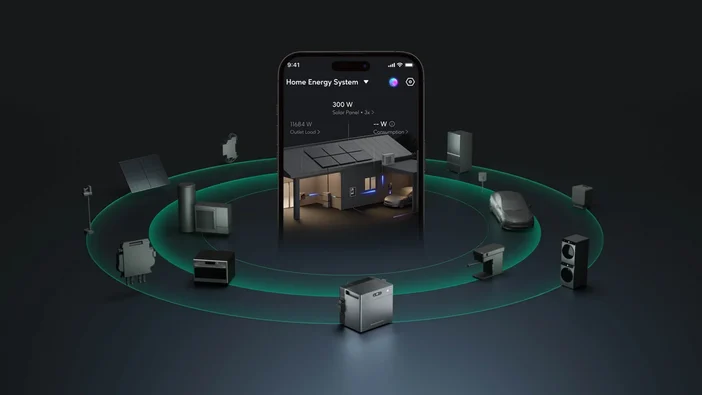
ZENKI 2.0 is the AI responsible for predicting and optimizing: in ZENKI mode, Zendure announces savings improvements of up to 73% compared to “standard” operation, relying on grid signals, weather, solar production, and the electricity contract. There is also talk of an “AI Robot” in the app, to guide the user and provide proactive maintenance.

A small detail that will resonate with “home automation” readers: Zendure clearly states the MQTT support, with compatibility for Home Assistant and Homey, and the possibility of more personalized energy scenarios.
ZenGuard: multi-layer security, self-maintenance and integrated extinguishing
Regarding security, Zendure highlights ZenGuard, a battery protection system based on a dual BMS architecture (one independent local BMS + a cloud BMS as an additional layer), self-maintenance (managing the mini SOC, self-heating in low temperatures, AC+PV charging strategies), and an aerosol extinguishing system activated around 170°C in case of overheating or failure.
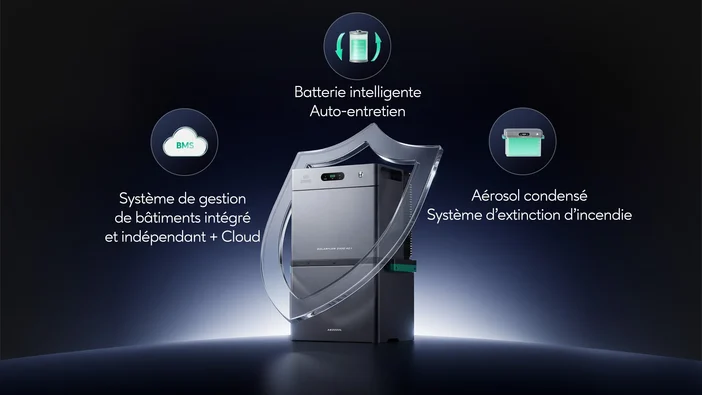
The objective is twofold: to limit risks and to keep the battery “healthy” even when solar production is low (winter) or when the system is left unattended for weeks (it happens, especially when everything works…).
ZenWave: the dynamic electricity offer that complements the “hardware + software”
Zendure no longer just sells batteries. The brand also promotes ZenWave, a dynamic pricing electricity offer, initially announced in Germany, based on the EPEX SPOT market, with integration into the app and management via ZENKI. Zendure emphasizes the “cheaper, simpler, greener” aspect with 100% certified green electricity, and even the possibility of benefiting from negative price hours (where charging can effectively turn into earning money in some cases).
Zendure presents example figures: a household in Leipzig at 5,000 kWh/year could save up to €620/year compared to a local fixed rate. And when ZenWave is combined with SolarFlow storage + ZENKI, Zendure talks about savings potentially reaching €2,121/year in certain scenarios.
ZenWave is also presented with a “low fee” pricing structure, with a base subscription of €4.99/month and service fees of €0.0159/kWh. Will this eventually come to France?
Compatibility: energy suppliers, home automation and measurement equipment
Zendure announces integration with more than 840 energy suppliers in Europe to collect pricing data and optimize planning, with examples mentioned for France (EDF, Engie, TotalEnergies, Enercoop…).
For home automation and measurement integrations, the manufacturer mentions MQTT and compatibility with Home Assistant / Homey, as well as possible gateways with energy tracking brands (Shelly, EverHome, HomeWizard). The idea is quite logical: if the house already has a “vision” of its flows, Zendure wants to be able to connect to it rather than forcing you to replace everything.

Which model to choose?
If the goal is a new installation or an increase in power (very sturdy balcony, or roof + desire for a system capable of handling it), the SolarFlow 2400 Pro is the natural candidate: 4 MPPT, up to 3000 W PV in DC and a bi-directional AC power rated at 2400 W. It is typically the model “I want margin” to smooth out power peaks in the evening and store as much as possible during the day.
If the house already has a solar roof and the goal is to add storage without touching the existing setup, the SolarFlow 2400 AC+ clearly targets this premium retrofit: same philosophy of 2400 W, same extensibility up to 16.8 kWh, and a message oriented towards “old system, new power.”
If the solar installation is more modest or if consumption does not require large power, the SolarFlow 1600 AC+ makes sense: more accessible, sized for moderate needs, while staying within the same software ecosystem (HEMS / ZENKI / integrations).


Please remain courteous: a hello and a thank you cost nothing! We're here to exchange ideas in a constructive way. Trolls will be deleted.