



Résumer cet article :
Navimow unveiled its new range of robotic mowers at the CES in Las Vegas at the beginning of January. But we were still missing many details. The manufacturer shed light on its entire range during an event that took place in Paris yesterday, which I was fortunate to attend. Navimow this time makes a promise that resonates with everyone: stop “messing around” with the installation, avoid signal issues under trees, manage narrow passages neatly, climb slopes without turning the lawn into a battlefield, and remain reliable on a daily basis. The brand sums this up with a home philosophy: a technology that should “be forgotten” once in place, freeing up your time. This is a recurring theme hammered home during the conference, and we find it in the product announcements.
Specifically, Segway Navimow unveils a 2026 range structured into six families: X4 series, H2, i2 AWD, i2 LiDAR, i2 LiDAR Pro, and Terranox. The idea is to cater to both residential gardens (from compact to very large) and, notably, professional uses with a dedicated range.
What really changes in 2026: “drop and mow” installation and multimodal navigation
The most interesting (and concrete) message from this 2026 generation is the desire to move towards a “unpack, place, mow” installation. Navimow highlights a “drop and mow” logic: no peripheral wire, no relay antenna to install, and a mapping system that aims to be increasingly autonomous via the app. The manufacturer thus emphasizes Auto Mapping and map creation via GeoSketch, with the ability to manage up to 120 virtual zones (mowing zones and exclusion zones).

Behind this ease of use lies a major evolution in navigation architecture. Navimow speaks of multimodal navigation and an EFLS (Exact Fusion Locating System) that combines several “senses” (RTK network, vision, LiDAR depending on the ranges) to maintain accuracy when the garden becomes challenging: dense trees, close walls, narrow passages, night mowing…
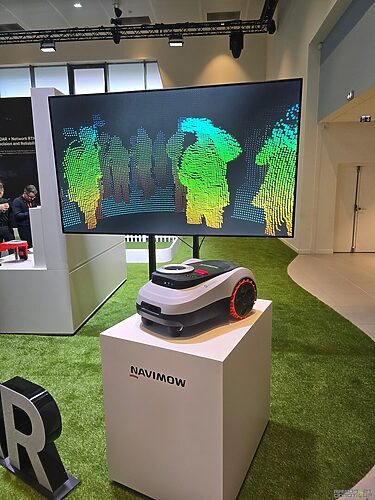
A notable point announced on stage: the arrival of Network RTK, which aims to eliminate the need for a local reference antenna (and thus the eternal question “where do I put the RTK station?”). The idea is simple: the robot connects via 4G and uses a network RTK operated by providers, with the promise of almost zero maintenance (no seasonal repositioning, no adjustments). Good news: for residential models, this network RTK is announced as free for location.
The two “signature” innovations of Navimow in 2026
Navimow focuses on two technical pillars in its range.
The first is Xero-turn AWD (all-wheel drive designed to be gentle on the lawn). The challenge is well known: a powerful robot that makes “tank turn” U-turns can damage the lawn, especially on sharp turns or wet ground.
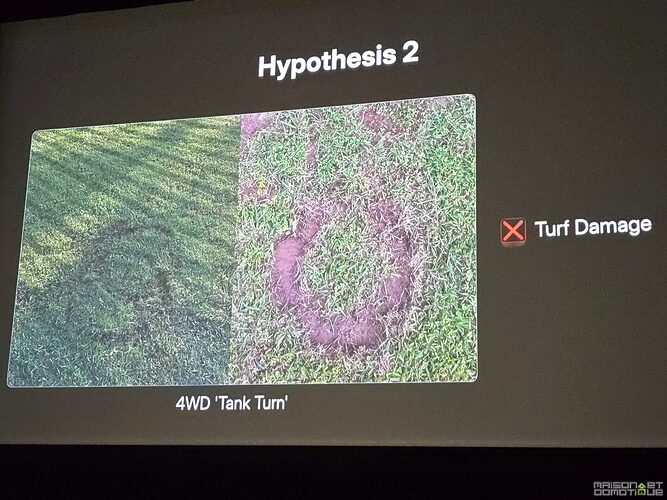
The brand explains it has developed an active steering logic and traction control (TCS) to pivot in place without tearing out the grass, and to maintain stable traction on slippery surfaces.

The second is EFLS LiDAR+ (triple AI fusion), which combines LiDAR (semiconductors / solid-state), Network RTK, and vision depending on the case.

During the conference, Navimow emphasized dynamic fusion: the robot does not just “switch” stupidly from one sensor to another; it continuously reevaluates the trust placed in each source (RTK useful in open sky, vision useful when visual landmarks are rich, LiDAR useful for geometry and at night).

It should be noted: Navimow claims the integration of a solid-state LiDAR (with no moving parts), capable of analyzing the environment at very high density (3D point cloud), aiming for robustness and stability over time, including for night mowing.


The Navimow 2026 range at a glance: who does what, and why there are several series
The range becomes rich, so the simplest approach is to read it as a staircase:
- i2 = entry-level (small to medium gardens) with variations depending on terrain and exposure
- H2 = “complicated” gardens (trees, passages, night, mixed zones) where stability is paramount
- X4 = large residential plots and performance demands (steep slopes, dense grass, efficiency)
- Terranox = professional maintenance (very large areas + fleet management)
Navimow X4: the premium series for large residential gardens (and very steep slopes)
The X4 series clearly targets gardens where a “standard” robot starts to struggle: large areas, elevation changes, uneven terrain, dense grass. Navimow highlights a slope capability of up to 84% (40°) thanks to the Xero-turn AWD, a very aggressive figure on paper.

On the cutting side, the brand talks about the MowMentum system: a large deck with two discs and 12 reinforced blades, two cutting motors of 180 W, a cutting width of 430 mm, and an EdgeSense logic for cleaner edges. The announced efficiency is 2,000 m² in 8 hours, aided by rapid recharging.

In terms of navigation, the X4 series combines triple frequency Network RTK, 360° VSLAM and visual-inertial odometry (VIO), with centimeter positioning and the removal of a physical antenna thanks to the EFLS NRTK. Compatibility with Apple Locator, Google Home, and Amazon Alexa is also mentioned.

Recommended models and areas:
- X420 (up to 2,000 m²),
- X430 (up to 3,000 m²),
- X450 (up to 5,000 m²).
Announced availability on 31/03/2026, starting at 2,499 €.
Navimow H2: the “complex gardens” series, designed to function anywhere, anytime
The H2 series is presented as the choice for demanding lawns: trees, narrow passages, night mowing, mixed zones… It integrates EFLS LiDAR+ (LiDAR + Network RTK + vision) and announces a mode switch in 20 ms for uninterrupted operation. The manufacturer states it can detect obstacles as small as 1 cm, identify more than 300 types of objects, and is suited for slopes up to 45% (24°) via Terrain Adapt and electronic stability control (ESC).

During the conference, Navimow also highlighted the “experience” layer: GeoSketch Real Scene map (a more realistic map thanks to LiDAR and vision) and a “terrain layer” in 3D to visualize slopes and contours, with a more intelligent trajectory planning according to zones.

On the security side, the 2026 range announces a 4-level system (GPS tracking, geo-fencing alarm, lift alarm, Apple Locator), with an integrated 4G module and at least one year of included subscription.
Models H2 and areas:
- H206 (600 m²),
- H210 (1,000 m²),
- H215 (1,500 m²),
- H230 (3,000 m²).
Announced public prices: from 1,599 € to 2,499 €, available now.
Navimow i2 AWD: the choice for “small gardens + difficult terrain,” without busting the budget
The i2 AWD is the answer to small plots that are not “as flat as a billiard table” (and this is more common than what robotic mower manufacturers like to admit). Navimow presents it as the only robotic mower in its category with all-wheel drive, featuring a 3-wheel drive architecture and intelligent management of the third wheel “on demand,” which is said to save up to 30% energy compared to permanent AWD.

It is rated for slopes up to 45% (24°), with ESC (electronic stability control) and more stable operation in mud/slippery ground.

References and announced public prices: i205 AWD, i206 AWD, i208 AWD, i210 AWD, starting at 999 € (surface areas indicated 500 to 1,000 m² depending on the version). Available now.
Navimow i2 LiDAR: the “setup free” option with LiDAR for small to medium gardens, especially when the signal is erratic
The i2 LiDAR focuses on a high-precision LiDAR (semiconductors / solid-state) and GeoSketch to facilitate automatic mapping and customization in the app.

The advantage is to maintain solid navigation where many RTK-only robots become more sensitive: narrow passages, dense trees, night mowing.

We find the following references:
- i208 LiDAR (800 m² – 1,199 €),
- i210 LiDAR (1,000 m² – 1,199 €),
- i215 LiDAR (1,500 m² – 1,399 €),
- i220 LiDAR (2,000 m² – 1,599 €).
Available now on the official site or on Amazon.
Navimow i2 LiDAR Pro: the “all-conditions” version for more demanding gardens, with steeper slopes
The i2 LiDAR Pro is presented as a step up: a more complete fusion (triple fusion) and a slope capability of up to 55% (29°), compared to 45% for the i2 LiDAR.

Two versions are listed: i210 LiDAR Pro (1,000 m² – 1,599 €) and i220 LiDAR Pro (2,000 m² – 1,999 €), with availability announced on 31/03/2026.
Navimow Terranox: the official entry into the pro market (very large areas + fleet management)
This is the strategic shift of 2026: Navimow “officializes” a pro range, designed for commercial green spaces and service providers. The Terranox series announces coverage of up to 24,000 m², an all-wheel drive, and the ability to mow the equivalent of a football field in a day.

Two models are mentioned: CM120M1 (up to 12,000 m²) and CM240M1 (up to 24,000 m²), associated with Fleet Management software to manage multiple machines remotely, monitor conditions, optimize operations, and benefit from dedicated support.

Public prices: 5,499 € (CM120M1) and 6,999 € (CM240M1), available now.
Which model suits whom: the simple Navimow guide to choose without error
If the terrain is small to medium but has slopes, slippery areas, or soil that “lives” (roots, small irregularities), the Navimow i2 AWD is the logical choice. It aims for the best simplicity/traction ratio on areas of 500 to 1,000 m², without reaching the prices of higher ranges.
If the garden is small to medium and the priority is stability in navigation under difficult conditions (dense trees, tight corners, or mowing in the evening), the Navimow i2 LiDAR makes sense: the solid-state LiDAR is specifically presented as the component that helps when the sky is not “perfectly clear.” It’s also a reassuring option if you want to limit installation hassle and keep the mapping easy to adjust in the app.
If you find yourself in the case of “not so small, not so simple garden” (more serious slopes, sportier configuration, a need for reliability under all conditions), the i2 LiDAR Pro is the bridge between the entry-level and premium. Its advantage is to go further on the announced slope and on navigation robustness, without switching to a robot designed for 3,000 or 5,000 m².
If your garden is “complex” in the landscaping sense (multi-zones, trees, passages, border constraints, need for precision, and a robot that doesn’t stop at the first issue), the H2 series is the most coherent. Navimow positions it as the range that removes the question “RTK, vision, or LiDAR?” because it combines all three. And the addition of the realistic GeoSketch map + 3D terrain clearly aims at users who like to refine (or installers who want something neat to deliver).
If you have a large residential plot (2,000 m² and more), with slopes and grass that can become dense, the X4 series is the high-end “performance” option. This is where we find the 43 cm cutting width, cutting power, announced efficiency, and high slope capacity. Typically, it’s the range that targets those who no longer want to compromise between power and lawn respect.
Finally, if you are a landscaper, site manager, camping manager, community, or maintenance service provider, the Terranox series is the professional answer, especially because it comes with the fleet management logic (Fleet / supervision hub) and a surface capability that has nothing to do with residential.
Summary table: areas, slopes, prices, and dates
| Series | Models / recommended areas | Announced slope (according to documents) | Suggested retail price | Availability |
|---|---|---|---|---|
| i2 AWD | i205 to i210 (500 to 1,000 m²) | up to 45% (24°) | 999 to 1,199 € | 03/02/2026 |
| i2 LiDAR | i208 to i220 (800 to 2,000 m²) | up to 45% (24°) | 1,199 to 1,599 € | 03/02/2026 |
| i2 LiDAR Pro | i210 / i220 (1,000 to 2,000 m²) | up to 55% (29°) | 1,599 to 1,999 € | 31/03/2026 |
| H2 | H206 to H230 (600 to 3,000 m²) | up to 45% (24°) | 1,599 to 2,499 € | 03/02/2026 |
| X4 | X420 / X430 / X450 (2,000 to 5,000 m²) | up to 84% (40°) | 2,499 to 3,199 € | 31/03/2026 |
| Terranox | CM120M1 / CM240M1 (12,000 to 24,000 m²) | (not specified in detail in the table) | 5,499 / 6,999 € | 03/02/2026 |
Announced promotions for launch
Navimow accompanies the launch with announced promotions from February 3 to 15. Notable offers include free garage on several references (i1, i2, H2, X4), along with some additional discounts depending on models (for example, on certain i2 variations). Prices and terms vary based on references and distribution channels, so the main interest here is to keep the launch window in mind and to verify the exact reference of the robot before purchase.
Conclusion
Yes, there are more models, and at first it may seem intimidating. But the logic is quite sound: Navimow does not create “one robot for everything”; the brand segments by real uses. i2 for budgets and modest terrains, H2 for navigation complexity, X4 for performance on large areas and slopes, Terranox for professional use with fleet management. And in between, the true shift of 2026 is the obsession to eliminate installation and reliability irritants (Network RTK without an antenna, sensor fusion, more autonomous mapping).
So, which model will take care of your terrain?



Please remain courteous: a hello and a thank you cost nothing! We're here to exchange ideas in a constructive way. Trolls will be deleted.