


Résumer cet article :
Matter 1.5 has just been released, and it’s a big piece that fits into the connected home puzzle. Cameras, shutters, gates, smart garden, fine energy management… the standard takes a real leap, with very concrete uses for everyday life, but also for integrators and smart home enthusiasts.
On Maison et Domotique, we have been following Matter since its inception because its goal aligns perfectly with our playground: a home that is easier to control, interoperable, and more energy-efficient.
Matter 1.5: what’s changing at a glance
Matter 1.5 officially expands the standard to four major families of functions: cameras, “closures” (anything that opens and closes), soil sensors for the garden, and advanced building blocks for energy management, not to mention an improvement in data transport for demanding applications.
This version comes after the updates 1.4.1 and 1.4.2 which notably enhanced quality, testing tools, and certification. We are thus seeing a true increase in functionalities while maintaining a more robust foundation for manufacturers and platforms.
For readers who are already using Home Assistant, Jeedom, or the Apple Home, Google Home, Alexa ecosystems, this means one very simple thing: new categories of devices will be able to communicate via Matter, as soon as manufacturers and platforms integrate 1.5 into their updates.

Matter 1.5 finally puts cameras at the heart of the standard
This was the big absence from Matter since the beginning. Version 1.5 finally brings a complete profile for cameras, designed to cover a maximum of cases: video doorbells, indoor, outdoor cameras, spotlight cameras, baby monitors, pan/tilt motorized cameras, garden surveillance cameras, etc.
On the technical side, Matter relies on WebRTC for live video and audio, supporting bidirectional streams (conversation with the person at the door, for example) and support for STUN/TURN servers for local as well as remote access.
The camera profile allows managing multiple streams (for example, an HD stream for recording and a lighter stream for viewing on a smart watch), pan/tilt/zoom commands, detection areas, and privacy zones.
For a smart home installer, this opens the door to much cleaner scenarios: a single camera can, in theory, integrate into different Matter-compatible ecosystems without hacking proprietary APIs, while retaining advanced specifications in the manufacturer’s application if needed.
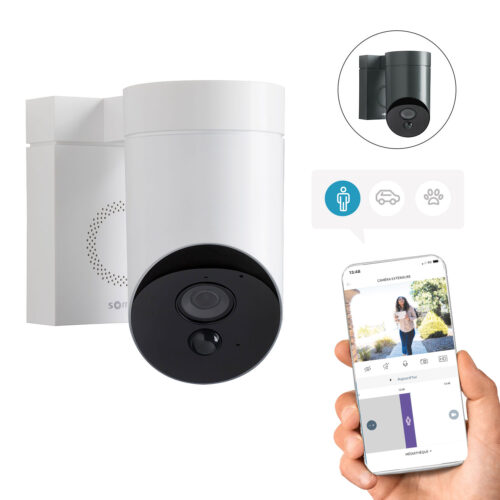
However, an important point to note: the camera specification does not itself manage storage or playback of recordings. It can point to local or cloud options, but clip management, history, and video analysis functions (person recognition, vehicles, etc.) remain the responsibility of each manufacturer or platform.
Another interesting detail for those who already own a fleet of cameras: the spec has been designed to be backward compatible with most modern cameras that already have the necessary processing power, memory, and Wi-Fi. But the ball is clearly in the court of manufacturers, who will need to decide which models will receive a Matter update… and when.
Closures: shutters, doors, gates, and garage finally unified
Matter already managed concepts of opening/closing, but in quite a limited way. With 1.5, the Alliance introduces a much more comprehensive “closures” category, covering roller shutters, blinds, curtains, awnings, gates, garage doors, and other motorized openings.
The architecture is based on a set of modular blocks that allows describing different types of movements (translation, rotation, vertical or horizontal opening) and different mechanisms (one or two leaves, interlocking mechanisms, etc.). For a manufacturer, this greatly simplifies how to describe a product in Matter while keeping the possibility to differentiate.
For the end user, the impact is seen in the control and feedback of status. One can hope for more precise information about the position of a shutter, detecting a gate left ajar, or the possibility of managing a solar protection system that can tilt and raise/lower more finely. The famous question “did I really close the garage?” can be addressed by Matter across a whole range of devices, and not just through proprietary integrations.
It should be noted that garage doors become certifiable in Matter, which had not been the case until now even if the topic had been on the table since the first version of the standard.
Soil sensors: the garden becomes a true Matter use case
Another less flashy but very practical new feature: the arrival of soil sensors. Matter 1.5 defines a profile capable of measuring soil moisture and, optionally, temperature.
Specifically, a sensor placed in a flowerbed, planter, or lawn can inform a Matter-compatible irrigation system (valves, solenoid valves, irrigation controllers already provided for in previous versions) to open or close the water based on thresholds, timings, or weather forecasts. One can imagine, for example, a scenario where irrigation is blocked if the soil is still sufficiently wet or if rain is expected in the next few hours.
For an individual new to smart home technology, this is a very concrete use case: less water waste, healthier plants, and no more wondering when returning from the weekend if the garden looks like a desert. For an installer, this also opens an interesting niche on connected garden projects, which are multiplying around new homes.
Advanced energy management enters a new phase
Matter had already laid the groundwork for energy monitoring. Version 1.5 goes much further with a new type of device dedicated to “electrical energy tariffs”: a profile capable of carrying information on energy prices, pricing structure, and even carbon footprint, in real-time or forecast.
The idea is to allow smart meters, energy provider services, or network operators to push standardized data to the home: hour-by-hour prices, peak and off-peak hours, critical days, carbon intensity of the kWh, etc. Other Matter devices (heating, water heater, electric vehicle, large appliances) can then adjust their operation to align with user preferences and pricing signals.
In many European countries, providers already offer plans with incentives to consume off-peak or inject solar energy into the grid at certain times. The new type of Matter device has been designed specifically to facilitate the ingestion of this data into the smart home ecosystem and make individual participation in these programs much smoother.
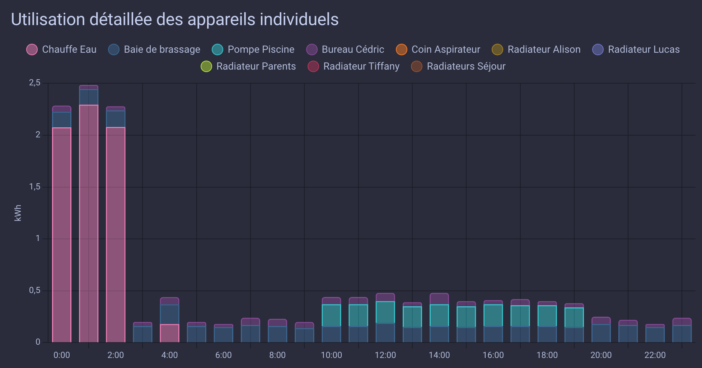
The spec also improves the “smart metering” aspect by better managing complex and variable tariffs over time, as well as consumption history, to provide a more realistic cost of usage.
On the electric mobility side, Matter 1.5 adds certifiable functions around vehicle charging: reporting battery state, supporting bidirectional charging (vehicle-to-grid or vehicle-to-home), communicating power limits on the network side. This clearly prepares homes for scenarios where the car can become a battery for the house, while respecting local constraints from the network operator.
One can easily imagine a combo of solar-powered home + home battery + Matter-compatible charging station capable of optimizing when to charge, when to discharge, and when to relieve the grid, relying on dynamic pricing and the current carbon intensity.
TCP and large data volumes: a wider pipe for Matter
Last major technical aspect: Matter 1.5 adds full support for TCP transport, improving the handling of large data volumes.
For cameras, this allows more efficient management of certain heavy exchanges. But it is primarily uses like firmware updates, image transfer, or enriched data that will benefit, with faster, more reliable transmissions that are potentially less energy-hungry.
For an integrator, this is an important detail: fewer updates fail, fewer devices need manual intervention, and a more solid foundation for future functionalities that will require more bandwidth.
And for your smart home installation, what changes?
Even though spec 1.5 is officially available, different players still need to update their products: camera manufacturers, shutter manufacturers, irrigation, charging stations, as well as smart home platforms and voice assistants.
For a user of Home Assistant or Jeedom, the impact will unfold in several stages. First, the Matter stacks and Thread controllers will need to adopt 1.5. Next, software-side integrations will need to expose these new types of devices and their advanced functions (camera privacy zones, fine control of shutters, energy profile, etc.). We know the community: once the specs are public, the first prototypes and plug-ins will often arrive very quickly.
For professionals, this version clearly opens up new services to offer:
- multi-ecosystem compatible cameras without having to promise the client “it might work with such box”;
- centralized management of shutters, solar protection systems, gates, and garage doors with reliable status feedback;
- energy offers with automatic optimization according to price and network constraints;
- connected garden projects where irrigation is based on real soil data.
And to be honest, the connected home geeks will mainly be excited at the thought of playing with Matter cameras and scenarios such as: “if the door camera sees someone during peak hours, reduce the heating by 1 °C and delay the car charging.” This may not be everyone’s top priority, but it’s exactly the kind of thing that is enjoyable to see when you love smart home technology.
Conclusion
Matter 1.5 is not just a small evolution. Cameras, openings, connected gardens, energy: the standard tackles bricks that directly affect daily life and installers’ projects.
The first certified products will not arrive overnight, and adoption will depend on the goodwill of manufacturers and platforms. But the direction is very clear: Matter is gradually becoming the common language of the connected home, from the gate to the camera, including the meter and the charging station. And that’s exactly what we expect from a standard worthy of its name.



Please remain courteous: a hello and a thank you cost nothing! We're here to exchange ideas in a constructive way. Trolls will be deleted.